Thursday, October 14, 2010

Idea Post #6: Surrealism

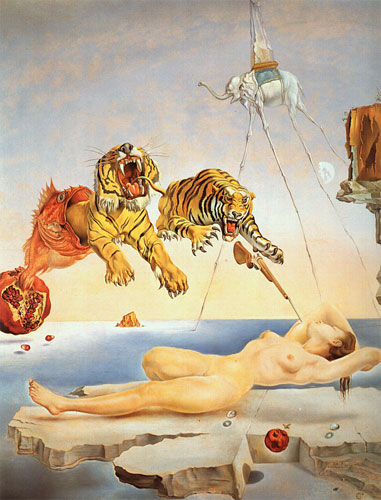
Salvidor Dali, Dream Caused by the Flight of a Bee around a Pomegranate a Second Before Awakening (1944)

Surrealism

Surrealism was created out of Dadaism. Poet, Andre Breton wrote many texts on defining Surrealism. From his first manifesto: “Psychic automatism in its pure state, by which one proposes to express -- verbally, by means of the written word, or in any other manner -- the actual functioning of thought. Dictated by the thought, in the absence of any control exercised by reason, exempt from any aesthetic or moral concern.” Breton is explaining that Surrealism isn't just expressed by poems but by many other art forms and just life in general. Where Dadaism was totally against most everything, like reason, surrealism was also against everything except dreams. Surrealist were very interested in Sigmund Freud and his theories on free association and dream analysis. Dadaist didn't see any point to having a real story to their work. It was just meant to provoke the viewer in some way. Surrealists knew that their dreams were important and tried to recreate them in art. Salvador Dali, one of the most famous surrealists, would get up and paint furiously what he just had been dreaming. There were two forms of Surrealism: one based on practiced improvised art where the artist would distance himself from the artwork and create works that were more from the subconscious. The other form was the one that Dali and Rene Magritte " used scrupulously realistic techniques to present hallucinatory scenes that defy commonsense." The first Surrealist Manifesto ends along the terms that surrealists follow no conventions or set pattern. They are led by their dreams and their unconcious mind.

How I think this works into my art: Its not all planned. Not everything in my work has to make sense. Not everything has to be real. In fact, most of my work is a trickery of the eye anyway. So very basically, I want there to be more room for nonsense in my work. I don't want to fall off into being cynical and to not believe in anything but some nonsense will help free my work.


Strickland, Carol, and John Boswell. The Annotated Mona Lisa a Crash Course in Art History from Prehistoric to Post-modern. Kansas City, Kan.: Andrews and McMeel, 1992. Print.

"Surrealist Manifesto." Wikipedia, the Free Encyclopedia. Web. 14 Oct. 2010. http://en.wikipedia.org/wiki/Surrealist_Manifesto.

Sunday, October 10, 2010

Artist Post #6: Janine Antoni

"Saddle"
2000
Full rawhide (cow), 25 2/3 x 32 1/2 x 78 5/8 inches

"Moor"
2001
Dimensions variable
Installation views, "Free Port," at Magasin 3 Stockholm Konsthalle, Sweden

"Loving Care"
1993
Installation view at Anthony D'Offay Gallery, London
The artist soaked her hair in hair dye and mopped the floor with it.

"Lick and Lather," detail
1993
7 soap and 7 chocolate self-portrait busts, 24 x 16 x 13 inches each


I don't think I'll be able to make this lecture so I'll do a post on her instead.

"Janine Antoni, a 46-year-old native of the Bahamas, received her B.A. in 1986 from Sarah Lawrence College and her M.F.A. from Rhode Island School of Design in 1989. She received the MacArthur Fellowship and the Joan Mitchell Foundation, Inc. Painting and Sculpture Grant in 1998, and the Larry Aldrich Foundation Award in 1999."

I see a trend in many of the artists I am choosing. My interest in them are all very similar. I enjoy the act of making. Janine Antoni also expresses this same liking for using your hands. Antoni uses her hands, hair and body to create her art work. There are so many joys and acts that she captures in her art work. She learns how to do old feminine type work with her hands like spinning (not on a stationary bike) and loom weaving. I do not consider myself a feminist but with most works that deal with feminine processes and the way women used to act, I get a strong connection to the work. I am not sure where this feeling comes from. She also just uses her own body to create work. For Loving Care she uses her hair and hair dye to paint the floor of a gallery. She says that she likes to use her body in her work because then other people can feel her presence. It is also helpful that he body is there so and the viewer can empathize with what she has done to create the artwork. She also uses the theme of her family and her life in creating Moor. In this work she weaves together a large rope that she twists and combines herself. The pieces come from special things from all of her friends and family. They can be anything from dresses or electrical cords. She weaves and uses her hands and has her mother help weave with her too. The process is as much of the art as the final product is. She taught herself how to tight rope walk and she made a video where she is walking on the horizon of her childhood view of the beach. History and making things and use of different types of media are so interesting to me!

" I just believe in the power of art, what it can do for our lives. I think if you stay focused on what art can do and don’t get distracted, you discover it is limitless. "
- Janine Antoni via Bomb magazine

"And because "Moor" is made out of materials from my friends, I thought I could make a rope from materials of my life and walk it like a lifeline."
-Janine Antoni via Art 21

LINKS:


"Art21 . Janine Antoni . Biography . Documentary Film." PBS. Web. 11 Oct. 2010. http://www.pbs.org/art21/artists/antoni/index.html.
Horodner, Stuart. "BOMB Magazine: Janine Antoni by Stuart Horodner." Editorial. BOMB Magazine Jan.-Feb. 1999. BOMB Magazine: Home Page. Jan.-Feb. 1999. Web. 11 Oct. 2010. http://bombsite.com/issues/66/articles/2191.

artist rant? Erin Tyner

Yellow, 2008
Above, 2008
This post isn't so much about the photographer its about photography for everyone. This is an artist that I found about two years ago when I started thinking and using cutouts in my photography. Erin Tyner is a self taught photographer from Atlanta, Georgia. She has a series that she made in 2008 called Half Awake. She uses model people and other household objects to create a diorama and then photographs them. "In my Half Awake series I construct scenes by combining household items, natural objects, and train figures under one inch in height. By pairing figures and context I create characters that are engaged with an unfolding narrative." When I first found her on the internet I felt fooled. I felt like I had come up with a way to use photography the way that I want to. In a way that made sense to me. And this self-taught photographer had come up with the same idea as me. This led to questions like: Why am I paying so much money to study photography when I can just own a camera and make the same conclusions about art? Or what am I doing that is interesting in any way? I think with flickr and ffffound and other sites like this make me feel inadequate as an artist. What interests me is that "hipster" photography is so over used all over the internet. And then there are people that take amazingly perfect and dynamic images with their expensive cameras. As a photography student I feel like I am swimming upstream. I have a not top of the line digital camera and all the other film cameras I have are pre-owned. Its a pretty defeating feeling. Also, the fact that Erin Tyner shares and name with me is just the icing on the cake.
So I have since realized that it is not about the camera you have, or the art school education but how you put your tools into effect. Half Awake series isn't the best but its the best of her works. There are some images that are really beautiful but to me don't have that much behind them. Even with Tyner in a small part of the photo world I feel that there is room for me. I have skills that I have worked on for a while now and need to perfect. I use the tools I have to the ways that work best. Tyner isn't represented by a gallery but she has her own etsy site. I suppose you just need to be a great entrepreneur to be a great photographer.

Website:
interview:
http://blanketmagazine.com/ (their latest issue)

Center for Fine Art Photography Submission

submitted to the Blue show!

Thursday, October 7, 2010

Idea Post #5: Repetition compulsion


Repetition compulsion is an inherent tendency in the unconscious that impels the individual to repeat certain actions, usually the traumatic ones. This is to master the traumatic event that the person could not master in the trauma itself. After reading this article it explains that not every repetitive compulsive act is out of trauma necessarily. That children that throw their favorite toy to the ground, is upset that it is gone, receives it from a parent, and repeats the cycle all over again. This too is a form of repetition compulsion.

I want repetition to fill my work. I want to repeat processes until they become subconscious. This is seen in the article that later repetition compulsion isn't just for people dealing with a trauma. It is also how people try to relate to others. Inside of your core, you want to be with other individuals. Your body and mind will act a certain way each time to try and gain friends. I am not trying to gain friends by making artwork but I want to do the same action over and over again until I have a new product. I want to cut out and create many characters and create new backgrounds to put them in. The repetition will keep the work changing and concepts will bend. I think it will be good.
"Repetition compulsion is a psychological phenomenon in which a person repeats a traumatic event or its circumstances over and over again"- Repetition Compulsion Info

compulsion /com·pul·sion/ (kom-pul´shun)
1. an overwhelming urge to perform an irrational act or ritual.
2. the repetitive or stereotyped action that is the object of such an urge.compul´sive

repetition compulsion in psychoanalytic theory, the impulse to reenact earlier emotional experiences or traumatic behavior.
-medical dictionary
"Compulsion - Definition of Compulsion in the Medical Dictionary - by the Free Online Medical Dictionary, Thesaurus and Encyclopedia." Medical Dictionary. Web. 07 Oct. 2010. http://medical-dictionary.thefreedictionary.com/compulsion.
"Repetition Compulsion Information (Freud) @ IAmPicky.com." Anal Retentive and Obsessive-Compulsive (Annoyance) @ IAmPicky.com. 27 Sept. 2010. Web. 07 Oct. 2010. http://www.iampicky.com/Repetition_compulsion/encyclopedia.htm.

Wednesday, October 6, 2010

Julika Rudelius Response

"I highly question even the idea of seeing the actual self on film." This quote was the most interesting quote to me. Her concept that film is never an exact replication of reality is something that I've always felt. I think that it ultimately completes almost all of her work. The tangle of truths that weave in and out of each other amazes me. Using actors to play others and shooting them as it were really happening is a way that Rudelius twists the truth. Or creating a fake set in which real people are shot on is a twist of the truth. But for me using film and photo to twist the truth in the end is the best way of complicating it all. The fact that many people watch videos or films or look at pictures and think that they are getting a great representation of what really happened is something that Rudelius (and all photographers and filmmakers) does every time she makes a video. Thinking that what you are seeing is real is something that cannot be trusted. Images are not to be trusted and I think that Rudelius has this in mind when she makes all of her work. I love that she used to help make documentaries.
To me acting, social class, and truth is what Rudelius's work is all about. She either hires actors or has real people act a certain way. A lot of her work deals with the social stature of the people in her videos. There are different ranges from socialites to immigrants. Truth is what Rudelius's work is about or the twisting of it.
Rudelius's work manipulates the viewer mostly into believing in what they are seeing is real. I like the amount of control from her work. It was inspiring. But also I would have liked to see her be a bit more loose with how she treated everything. Just to see what would happen. And I think in Your Blood is As Red As Mine she let a lot of things go. but there was still an air of scriptedness from it as well. That might just come from all of her other work and now I am just questioning all of the truths and realities in every different work. However, her control does allow the viewer to follow her and get exactly what she wants you to get from her work. This is something I need to adopt.

Monday, October 4, 2010

Julika Rudelius Q's

picture from artist's website.

All of your work has to do with social status in some way. Does this overall theme for most of work create a bond that makes your work a structured whole? Does your all of your work grow into a network that can be descriptive of the whole world?

with many of your videos you make it clear what is "real" and what is acted. Is it more natural to try and film people that are acting or to just film people? When you direct people to do certain things there is a way of manipulating the outcome. Do you want to manipulate your work further? Besides, editing and directing, could you introduce a type of manipulation that doesn't simulate reality?