Wednesday, March 30, 2011

Ryan McGinness response


Most interesting quote:
"Why should I make shoes? Well I wear shoes so thats okay."
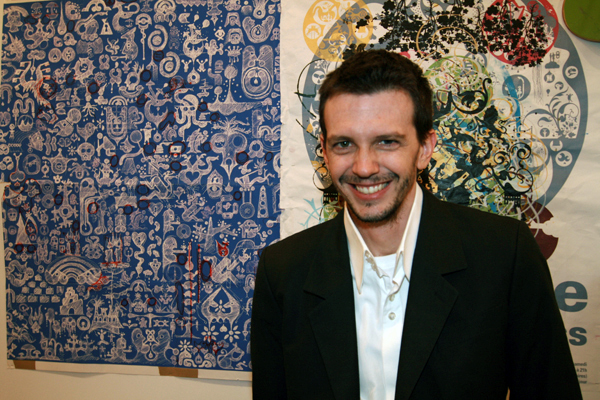
Ryan McGinness seemed to take his art seriously but not so seriously. His works are lighthearted and lightly conceptual. He wants to have fun with his work. His work is very visually pleasing and intricate. He is very much interested in design and sketching. At first glance the simplicity of the lines and figures made looks simple but then seeing the process and realizing that you could never make a symbol that perfectly represents something else, you understand the complexity of the whole work. That is very satisfying. McGinness's approach to art making and viewing changed for peice to piece but each starts out the same: with the sketch. He also said that he is not interested in making the viewer feel dumb.
Three words:
design, pop, art history
Most interesting work:
The work he did for VMFA was the most interesting to me. Its interesting to see which artworks he picked. They weren't really the most important or coveted they were just the ones he picked. Then it was great seeing the sketching process on how they became symbols. I found it interesting how he thought about art history. Its interesting to think about how art history isn't linear and that it is always building on its self. Working with and for a muesum to create this work is what brings it all together.
Answer to questions:
After moving to New York, do you find importance in your hometown of VA beach? (Not to offend) but do you find inspiration from coming back to Virginia specifically Virginia Beach?He said that he was interseted in how design communicated ideas simplicitcally. Even tough he was unaware of making a life in the art world based off of design he was inspired to create designs when he was in high school.

Your work for the VMFA is slightly humorous and very intelligent. A lot of your work is funny and slightly serious to me. How do you mix lofty, artistic ideas and still make them seem lighthearted, airy and often funny?
Ryan made it seem like he was never very serious. And now he is working on trying to gain more serious projects like the VMFA one. He said that you should only be and artist if you simply cannot deny being anything else. If you have to question being an artist then you just shouldn't become one. I think that since he has to be an artist he is going to make work that is interesting and kind of funny to him. Like his new women series that go up in strip clubs. funny times.


I also found it interesting that he admitted to doing screen printing "wrong". Or at least not how you are taught to do it. Its always refreshing that people admit to this.

idea Post #7: Silhouettes


Silhouettes
Etomology from Oxford English Dictionary:
Etymology: < the name of Étienne de Silhouette (1709–67), a French author and politician.

According to the usual account, which is that given by Mercier Tableau de Paris 147, the name was intended to ridicule the petty economies introduced by Silhouette while holding the office of Controller-general in 1759, but Hatzfeld & Darmesteter take it to refer to his brief tenure of that office. Littré, however, also quotes a statement that Silhouette himself made outline portraits with which he decorated the walls of his château at Bry-sur-Marne.

Silhouettes were originally a cheap way of creating a likeness of someone.

"The silhouette lends itself to avoidance of the subject. Of not being able to look at it directly, yet there it is, all the time, staring you in the face."

"I couldn’t really name these characters or caricatures in the way that the wall texts at the museum ... I think these figures are phantom-like. They’re fantasies. They don’t represent anything real. It’s just the end result of so many fabrications of a fabricated identity."

-Kara Walker


"Art21 . Kara Walker . Interview & Videos | PBS." PBS: Public Broadcasting Service. Web. 31 Mar. 2011. http://www.pbs.org/art21/artists/walker/clip2.html.

this Interview is about how Kara Walker uses silhouettes and her adaptation of Gone With The Wind. Kara Walker is a contemporary artist today that uses silhouettes in her art work. She talks about race and slavery and the history of African Americans. Her silhouettes are placed directly on the wall and in some works she projects color lights on the the wall as well. This way as viewers are looking at the characters they are also creating their own silhouettes on to them. Walker looks to historical paintings as a hidden inspiration. She didn't realize how much she related to them until she started making work with silhouettes. She understands the idea of creating history through a painting is like setting a stage with the important people of the time. Walker in her own way is telling a different version of history with her characters, set out on a wall that acts as a stage. This creating of characters is quite interesting to me. I do not wish to rewrite a history as grand as America's but just telling my own story with characters I create. I believe I've been doing that all along with the cutouts I've made. Now using the silhouette is creating a whole different cast of characters among the ones I've already created. The history of the characters is growing and changing.


Second edition, 1989; online version March 2011. ; accessed 31 March 2011. Earlier version first published in New English Dictionary, 1910.


Tuesday, March 29, 2011

Ryan McGinness Question


After moving to New York, do you find importance in your hometown of VA beach? (Not to offend) but do you find inspiration from coming back to Virginia specifically Virginia Beach?


Your work for the VMFA is slightly humorous and very intelligent. A lot of your work is funny and slightly serious to me. How do you mix lofty, artistic ideas and still make them seem lighthearted, airy and often funny?

Saturday, March 26, 2011

Kiyomi Iwata response

Kibiso Two, 2009, 10x17x13" Raw silk is dyed, woven and stiffened
Kiyomi Iwata
interesting quote/most interesting aspect:
"Essentially what I do in the studio is play!"
This was very refreshing to hear. I found Kiyomi Iwata's work interesting and engaging to look at. She herself was adorable. Her work wasn't overly conceptual. The materials were not overly worked. There is an intricate simplicity to everything about it. When asked why she made smaller pieces she responded easily, "I am the boss! I am the one who must create the work..." implying that her small stature makes it difficult to create much larger works. She then uses that to create concept. She likes the intimacy of her pieces. And the small pieces speak for the larger ones knowing that she had to make small trial sculptures first to then make them big.
For me it was just great to see interesting work that is slightly conceptual but mostly visual. I felt great hearing her speak about it very plainly about process and technique. It was a breath of fresh air with all of the conceptual artists coming to talk and being in senior portfolio where concept is the emphasis. She talked about how she has to work with gold when its colder and dryer because of the adhesive she uses to apply the gold compound to the metal. The adhesive will become too "wet" and allow the gold to oxidize when she adheres it in the summer. This working for the seasons is an old tradition in Japan. She said it feels poetic to make things seasonally, almost romantic. She did not choose to create work seasonally but since she did she related her work to ancient manufacturing and this rises the meaning of the original work. This concept was created post-creation which is something that few artists admit to.
Three words:
scale, recycle, tradition
Most compelling work:
For me the work with Kibiso is very interesting. Kibiso is the rejected part of the silk threads that are never made into kimonos. It is collected and usually just thrown out but Iwata uses it to great gorgeous sculptures. The work does not look like reclaimed trash (essentially) but a beautiful art piece. I think it speaks about her leaving Japan and moving to America. It is how she can recreate her own life in the West by reclaiming her culture in the East.

Wednesday, March 23, 2011

Kiyomi Iwata questions

Kiyomi Iwata

q: Do you find hidden meaning in using discarded thread from kimono makers? Does this correlate to how you moved from Japan to America?

q: Silk and metal are very different materials. However, you use them in similar ways to create vessels. What commonalities do you see in these two materials? Do they functions similarly to you?

Laurel Nakadate response

Laurel Nakadate

Interesting quote:
Well everything that Nakadate said during this lecture was very interesting to me.
"The world is great-trust it."
This is how she described her filmmaking process. She went to shoot Stay the Same Never Change in Kansas and for many of the shoots she hadn't seen the locations until that day of the shoot. She said that for so many of the location they were just perfect and worked out so well for her. This is inspiring to me to see what she created with little manipulation. I find in my practice I try to do the same thing. I try to let my life go with it. I try to let my work go with what is going on. Or at least I try. I try to be more free.

Three words:
Futile, travel, truth

Most interesting aspect of artist:
I think Nakadate's attitude was the most interesting part to me. She was humorous and serious at the same time. She had conviction with all of the work she made but also had conviction in the silliness of her work. She understood what had to be done. I love that she was interested in the fabrication of recording events. That life has importance after it has been recorded in some fashion. She recognizes the power of photographing or recording an event and the power lies within the camera. She is one of the first artist to say that she finds comfort in her camera and I actually understand. I have not really felt this comfort before. However, the way that she describes it makes more sense to me than it ever has to me.

Most Compelling work:
Once again I found all of her work special and great for one reason or the other. For her work that she did with strangers she describes the situation as: "Anyone that would spend time with anyone at anytime is beautiful." YES. Human connection is a beautiful thing. The fact that complete strangers want to collaborate with her and create art with her is so beautiful. That people everywhere are just looking for connection to others. Nakadate has found so many different ways to reach out to others in her work. It is touching and tender to me. I don't find her work exploitive because the people in her videos just represent what all humans want and live for.


I was able to talk to Nakadate for just a few minutes after her lecture and it was great. She is half Japanese too and she knew I was right from meeting me. Aw best birthday ever.

Tuesday, March 22, 2011

Birthday Artist Lecture: Laurel Nakadate


q1: How are you always the hunter? Are these men ever hunting you?

q2: How do you feel about using your own body and self in the crux of your work?And as you make feature films is it hard to hand over your ideas to others? Do you find it hard to video other girls creating the art you want?


"I’m interested in discomfort. Discomfort is a place where we’re still close enough to comfort to understand our unhappiness. Most of the things we desire are things that can destroy us."

I think I"m going to really enjoy this lecture.


this interview with Laurel Nakadate is just perfect. The way she describes happiness and discomfort and everything is exactly how I have lived my life since birth.